Showing posts with label discovered. Show all posts

Sunday, May 30, 2010

Carnotaurus Dinosaur


Carnotaurus mean's 'carnivorous bull'.it was discovered by Bonapare in 1985. there are 3 classification of Carnotaurus Saurischia, Theropoda and Abelisauridae. There remains from South America.

They have 7.5 metres length, 3 metres height and 1 tonne weight of dimensions. The food was carnivore.

Canotaurus was a large biped predator. The head was strong and imposing, with the teeth serrated like butcher's knives. The most distinctive features of this dinosaur were the two protuberances on its skull, like flat horns emerging above the ayes and its very short nose. Its arms were also unusual, very small in relation to the body, with a well-developed humerus but an extremely small radius and ulna.

There were four digits on the hand, one of which, unusually, turned inwards. Scientists have not yet established what purpose the very small arms serve, with the digits arranged in this unusual mannner.

The only remains of Carnotaurus were found in the prairies of Patagonia in Argentina in 1985. The palaeontologists were lucky enough also to find strips of fossilised skin, so they could form a more accurate idea of the external appearance of this creature. From the neck to the tail the skin had rows of small conical protuberances, while on the head were smaller little humps from which ran rows of large protuberant scale, covering the area round the eyes and the upper part of the nose.

Wednesday, May 19, 2010

Carcharodontosaurus Dinosaur


The name means 'lizard with shark's teeth' because the teeth of Carcharodontosaurus recall those of Carcharodon, the elastmobranch genus to which the great white sharks belongs.

It discovered by Stromer in 1931 and found in North Africa. There are 3 classification Saurischia, Theropoda, Carcharodontosauridae.

It has 14 meters length, 4 metres height and 8 tonnes weight of dimensions. There food was carnivore and carrior eater.

According to reconstruction by paleontologists, Carcharodontosaurus was one of the largest carnivores ever to exist. Its body nonetheless looked elegant and slender, with a long tail, a strong neck , powerful hind limps, well-developed front limps and hands with three digits and sharps claws. The head was particularly impressive for its size of a human and for its dozen of very sharp teeth, up to 12 centimeters long.

Carcharodontosaurus came into the limelight in 1995 when the palaeontologist Paul Sereno and his team, working deep in the desert, discovered the remains of a new specimen a complete half-skull, some vertebrae, parts of the limps and the pelvis. It was a sensational discovery in that the head alone was almost 1 metre 70 centimetre long. This rivalled the skull of the largest Tyrannosaurus rex ever found.

Thursday, April 29, 2010

Bagaceratops Dinosaur

<
Bagaceratops means "little-horned face". It was discovered by Maryanska and Halszaka Osmolska, in 1975. and the remains found in Asia.

There three classifecation of Bagaceratops, Orrnithischia, Marginocephalia, and Protoceratopsidae.
It has a dimensions of 1 meter length, 50 centimeters and 22 kilograms weight. There food was herbivore.

Bagaceratops was a quadruped dinosaur, small but powerful, with a distinctive, toothed, bony crest along the back edge of its skull and a small horn on its muzzle; it had strong jaws and teeth for finely chewing the vegetation on which it fed.

Bagaceratops is one of the dinosaur which was found in Mongolia and it is regarded as one of the most primitive of the ceratopsians. As well as fossilized skeleton remains, its nests and eggs have been found.
Now as then at the end of its mouth, it had a beak similar to that parrot, useful for cutting vegetation.


The skull of Bagaceratops

Tuesday, April 13, 2010

ARCHAEOPTERYX


Archaeopteryx, means 'ancient wing'. It is discovered by Meyer in 1861 and found in Europe. It has a dimensions of 50 centimeters length,25 centimeters height and 50 grams weight. There food was carnivore and insectivore.

Archaeopteryx, was a little like a small carnivore dinosaur and a little like a bird. Like all dinosaur, it had a long tail, sternum (the flat bone in the center of the thorax), three strong clawed digits on each 'wing hand' and a mouth with lots of sharp teeth curving inward. As with all birds, the Archaeopteryx had a wishbone, two 'big toes' pointing backward for perching on branches of trees and a body covered with plumes and feathers. This makes the Archaeopteryx a classic link in evolution which demonstrates how birds have developed from dinosaurs. It is believed that the Archaepteryx was a fine flyer.

Archaeopteryx is considered by many palaeontologist to be the oldest known bird. Study of the species has enabled scientists to understand the evolution of dinosaurs to birds and how they adapted to flight.

ANTONIO DINOSAUR


Antonio dinosaur, was affectionately nicknamed 'ANTONIO'-but perhaps too hurriedly, because it now seems that the example found was female! It belongs to a gnewly-discovered species and its scientific name was given to it when the results of the first excavations were published.

It is discovered by Tiziana Brazzatti in 1995.And it is discovered remain in Europe.

Antonio Dinosaur has three classification such as Ornithischia, Ornithopoda and Hadrosauridae. It has 4 meters length, 1.3 meters height and 700 kilograms weight. There food was herbivore.

Antonio was a biped dinosaur but it could also move on four legs.It fed on plant life which it minced of with rows of hundreds of teeth. It had a flat nose like a duck's beak and lived in herbs with others of its type.

Antonio, came to light in Trieste, at the Villaggio del Pescatore (Feshermen's Village) in the Duino area. It was the oldest and most complete example of a hadrosaur dinosaur to be found in the world, giving us important information as to how this group of dinosaurs developed and their possible area of origin.

ANKYLOSAURUS DINOSAUR


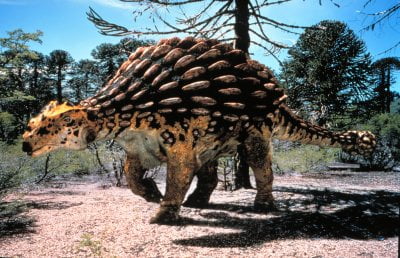
Ankylosaurus, means 'stiff lizard'. Clearly this name was chosen due to the rigidity of the bony Armour plated covering.
This was discovered by Brown in 1908. It remains many fossilized of the Ankylosaurus have been found in North America-but no complete skeletons.

It has a dimensions of 10 meters length, 2.5 meters height and 4 tonnes weight. There food was herbivore.

Ankylosaurus, was a massive, gigantic dinosaur, yet quite agile. It moved on four legs, keeping its front legs slightly bent sideways in order to support its weight better. Head, neck back and tail were all protected by thick plates of solid bone, one overlapping the next to form one side of the body to other and with rows of strong, pointed spokes-an impenetrable defense against the teeth and the claws of the fiercest predators such as the Albertosaurus and the Tyrannosaurus.

On its tail, the Ankylosaurus had a bony structure similar to a club-one powerful blow would be enough to break the bones of the enemy.
Some scientists believe that this club was used not only as a defense but also in ritual fights beetwen males in order to claim females during the mating season.


The only part of the Ankylosaurus not covered by the armour-plating was the abdomen-and so it is possible that during attacks by more than one enemy, it would crouch down in order to protect this unprotected area of the body.

Dinosaurs of the Ankylosaurus family died out at the end of the Cretaceous Period, between 65 and 68 million years ago.
Therefore they were among the last dinosaurs to populate the Earth before the mass extinction.

Now, as then the armour-plating must have completely defended the adult Ankylosaurus against attack by predators-especially when combined with its extraordinary size-as daunting as that of today's huge elephant, the hippopotamus and the RHINOCEROS.

ANATOTITAN DINOSAUR


Anatotitan, means 'gigantic duck' It was discovered in North America by Chapman and Brett-Surman in 1990. There are three qualification of Anatotitan Onithischia,Ornithopodopa and Hadrosauridae

It has the dimensions of 12 meters length, 2.5 meters height and 5 tonnes weight. There food was herbivore.

Anatotitan could walk very quickly on two legs but it normally run on four legs. Its front legs were shorter than its strong hind legs and its feet ended with three digits each with a hoof. Its head was low and flat and with a wide, long beak. It had hundreds of teeth in its mouth which it used to grind up twigs and pipe.

Anatotitan, was originally named Anatosaurus-the duck reptile. Some experts think that, when attacked by a predator, it would flee into deep water. Its wide tail would have helped it to swim very rapidly.

Anatotitan, did not have a crest like other hadrosaurs. Instead it had two empty sacs at either side of its mouth which it may have been able to inflate - rather like those of the ELEPHANT SEAL today-in order to produce a loud, fumbling cry.

Monday, April 12, 2010

ALLOSAURUS DINOSAUR


Allosaurus, means 'strange lizard'. The palaeontologist who discovered it thought that its bones were very similar to a lizard's. It was discovered in Marsh in 1877. Allosaurus remains have been found in North America, Europe, Africa, Astralia, Asia and India. It has 14 meters length, 5 meters height and 3 tonnes weight. And eat carnivore.

The enormous quantity of remains in a good state of preservation has enabled paleontologist to reconstruct the anatomy of the Allosaurus in fine detail. The Allosaurus was a powerful, agile animal,m
moving in two legs. Its skull was huge, its neck long and muscular. Its teeth curved inward and had jagged edges like a steak knife so as to cut through even the toughest skin. It would bite its prey, holding it firmly if it tired to escape. Its three-digit hands had strong, pointed claws, ideal for digging deep into its victim's flesh. It is thought that herbs of Allosaurus could have hunted for prey as large as the gigantic Camptosaurus and Stegosaurus. The head of the Allosaurus had a strange bony crest which could have been used to recognize members of a herd, or to distinguish male from female.

The Allosaurus could reach speeds of 30 kilometers an hour - with each leap measuring a good 3 meters! As it ran along, it kept its head down, its body parallel to the ground, with its tail, long and rigid acting as a balance to keep the body stable.
Many experts believe that the Allosaurous had a hunting technique very similar to today's tiger-a long wait and then attacking at the shoulder of the prey, suddenly and rapidly.